The Year Gaming Killed The Default Male Hero
In 2025, the gaming industry made a mistake.
Studios began releasing sequels that removed the male protagonist and replaced him with a woman. Not as an option. Not as a co-lead. Not as a side character with a bow and a tragic backstory.
Replaced.
Naturally, this was supposed to be a problem. The forums told us so. The comment sections warned us. Entire YouTube channels prepared postmortems for what this would mean for immersion, for sales, for the future of the medium.
And yet, something went wrong with the prediction.
The games got better.
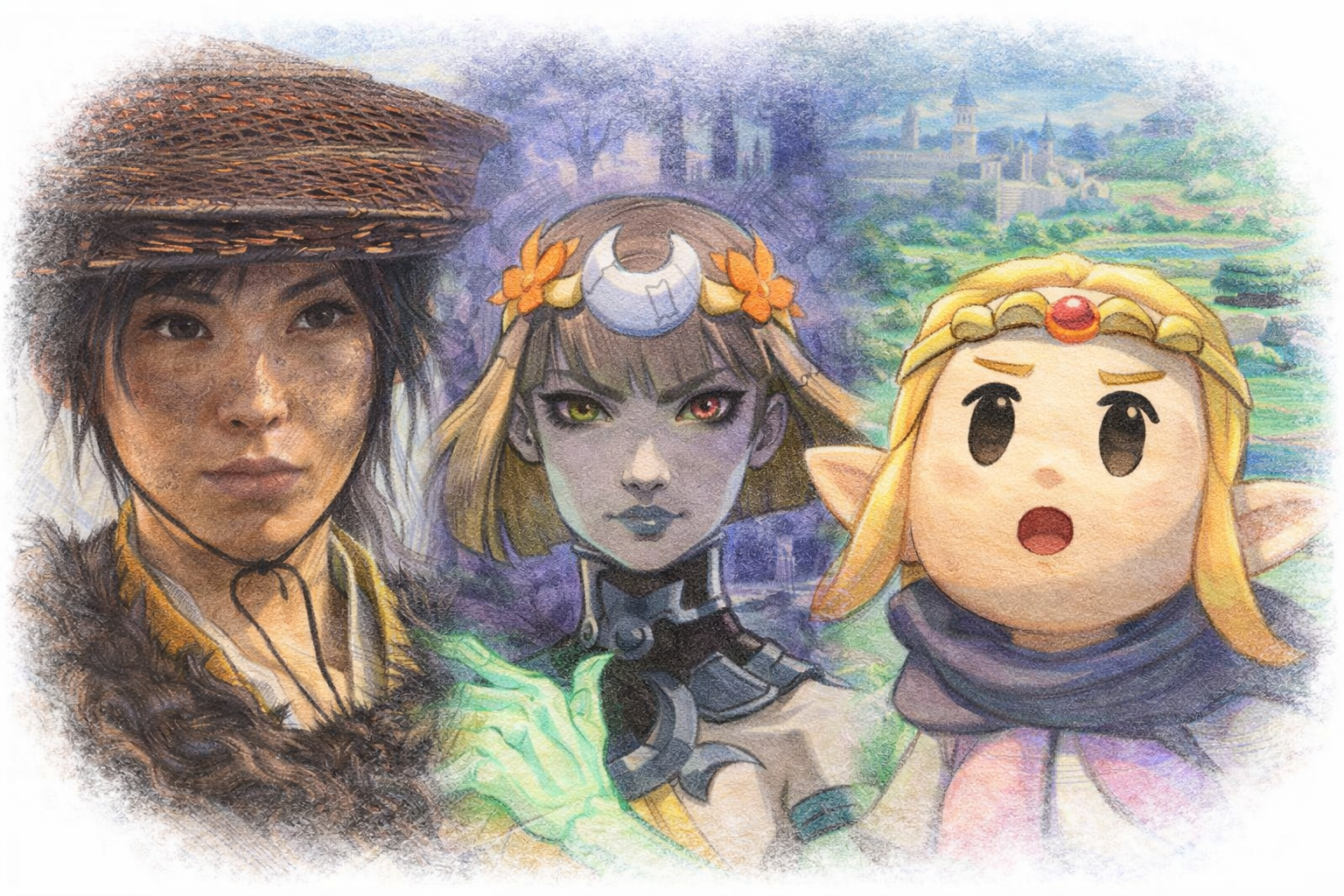
Ghost of Yōtei followed Ghost of Tsushima and made the decision to move on from Jin. Hades II replaced Zagreus with Melinoë. Hyrule Warriors: Age of Imprisonment removed Link entirely and centered Zelda. Even The Legend of Zelda: Echoes of Wisdom, the spiritual successor to The Legend of Zelda: Link’s Awakening, committed to the same direction.
No gender selection screen. No narrative chaperone. No fallback to a male lead to steady the experience.
Just a protagonist.
We were told, with confidence, that games led by women would struggle. That they would not sell, would not resonate, would not connect with audiences who needed a familiar anchor to engage with the experience.
Instead, we got something more straightforward.
We got good games.
Which raises a more useful question.
What if the problem was never the protagonist?
When a studio commits to replacing the default male lead, something practical happens. They cannot rely on the same systems. They cannot reskin the same mechanics and call it innovation. They cannot default to the same narrative template of stoicism, trauma, and obligation.
They have to build something new.
Hades II does not just swap Zagreus for Melinoë. It changes how you move, how you fight, how you approach encounters. Zelda does not solve problems like Link because the game is not designed for her to imitate him. The structure changes. The logic changes. The result improves because it has to.
This is the part that was never clearly stated.
The working assumption in parts of the industry was that female protagonists were a risk. That they needed to be optional, paired, softened, or limited in scope to protect performance. That audiences required a male lead to ground the experience.
What 2025 suggests is that this assumption was not a constraint. It was a habit.
You can see that habit clearly in Assassin’s Creed Shadows. The game introduces Naoe, a female shinobi, and immediately pairs her with Yasuke as a co-protagonist. The player is encouraged to switch between them, and the design itself splits along that line. Naoe handles stealth. Yasuke handles direct combat.
On paper, this looks like flexibility.
In practice, it follows a familiar pattern. The woman is present, but she is not allowed to stand alone. She shares the role, the mechanics, and the narrative weight. The game is structured so that the experience never fully commits to her as the sole protagonist.
This is not new. It is the same pattern I outlined in my earlier piece:
https://endofaspecies.com/oped/ubisoft-female-leads
The issue was never inclusion. It was hesitation.
When studios stop hedging and stop treating women as a feature, the outcome is not instability. It is clarity. The design sharpens. The narrative tightens. The world opens in ways it could not when everything had to orbit the same character template.
The shift is not about representation. It is about structure.
If this trend continues, we will likely see more sequels that move away from the default protagonist instead of preserving him. More games that justify their existence through design changes rather than familiarity. More studios recognizing that innovation sometimes requires removing the most comfortable piece in the system.
In many of those cases, the replacement will not be optional.
Which means the reaction will continue. There will be pushback. There will be arguments about immersion and identity. There will be claims that something important is being lost.
But the results will be harder to ignore.
The question was never whether a woman could carry a game.
The question was whether the industry could build something worth carrying without relying on the same protagonist over and over again.
In 2025, a few studios answered that question.
And the answer was simpler than expected.