Oh Yeah? Prove It.
Liberal Apathy and the Pedophile Adjacent Hall of Fame
There are two things I never expected to use as a framing device for political decay. Bipartisan moral rot and a Carlos Mencia joke. Before anyone panics, let me be brutally honest. Mencia was never funny. He built a career on stolen material and stereotypes, not punchlines. The one time he approached something resembling original thought, he delivered it in a cartoonish Japanese accent that audiences treated as “acceptable at the time” even though it was really just edginess for the sake of sounding edgy.
But the second joke he stumbled into, the one about the Menendez brothers, actually serves our purposes. Not because it was well crafted. Because the premise exposed something about institutional dysfunction.
The Menendez brothers murdered their parents and confessed on tape. There was no ambiguity. No mystery. No plot twist coming in the third act. Yet it still took two full trials to convict them. Mencia’s punchline captured the absurdity.
“We killed our mom and dad.”
And the jury said, “Oh yeah? Prove it.”
The jury is the key part. The joke works because the people entrusted with judgment behave as if certainty requires a scavenger hunt. It skewers the idea that institutions can look directly at a confession and respond with procedural gymnastics.
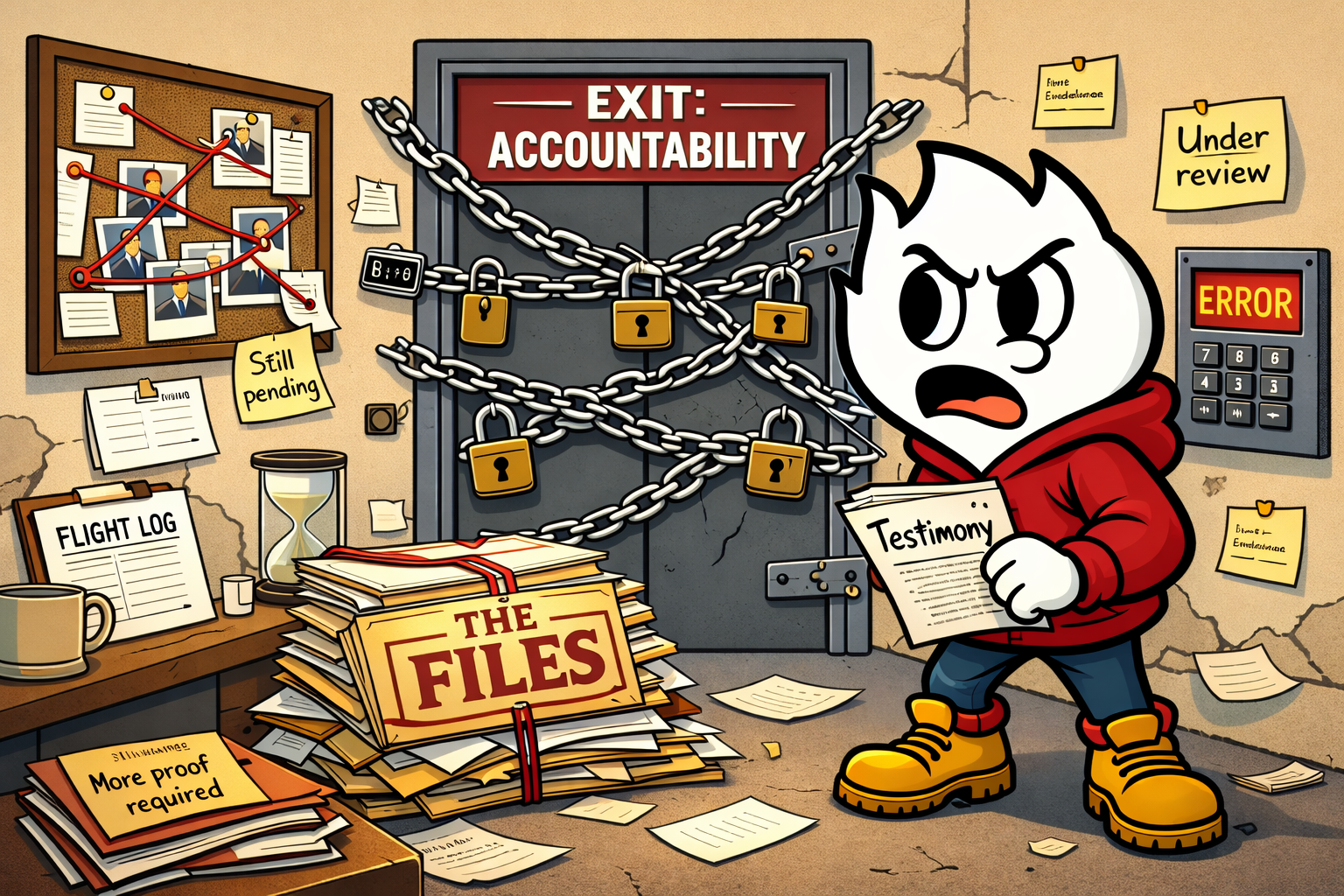
That punchline is also the perfect summary of America’s reaction to the Epstein files.
The Epstein Files and the National Shrug
The Epstein documents reveal a bipartisan cast of high-level degenerates. A full cross-section of American power. Politicians. Celebrities. Donors. Royals. Tech executives. The entire political spectrum represented like it was a gallery opening for the morally bankrupt.
And the reaction from the United States has been a collective shrug.
“Troubling, but we need more evidence.”
“Concerning, but let’s wait for corroboration.”
“Incriminating, but not quite enough.”
What makes the reaction even more embarrassing is that the United Kingdom, a country with its own long, storied, and very public “nonce” problems, managed to arrest a member of its elite class before the United States lifted a finger. This is the land that produced Jimmy Savile, Prince Andrew, and entire tabloid industries dedicated to sexual scandal. Yet somehow they acted faster on their slice of the Epstein network than the self-proclaimed beacon of global justice.
The American response sounds exactly like the Menendez punchline.
“They did it.”
“Oh yeah? Prove it.”
Not because proof is missing. Because accountability is inconvenient.
Nobody Else Gets This Level of Benefit of the Doubt
Here is where the absurdity becomes obvious. In every other corner of life, people do not tolerate this level of predatory behavior. They do not even tolerate the possibility of it.
If you, as a parent, see another couple sexualizing your teenage kids, you do not initiate a multi-month investigation.
If a friend shows up in a hot tub with a minor, you do not convene a review committee.
If your co-worker is caught taking flights to an island owned by a convicted child trafficker, you do not spend the weekend reviewing deposition transcripts.
Real people respond immediately because the stakes are obvious. And because normal communities enforce their own boundaries without waiting for forensic accountants.
The consequences are simple.
You get cut off.
You get confronted.
And depending on the severity, you start testing the fine print of your health insurance policy after someone decides to rearrange your face for being a creep. In other words, there are social costs. There are physical costs. There are consequences that make you miss work on Monday.
But when politicians do the same thing, the public suddenly becomes composed of constitutional scholars who believe that moral judgment requires a deposit of evidence so large it needs its own storage unit.
The gap between normal human standards and political standards is not an accident. It is structural.
Liberal Apathy Is Not Softness. It Is Liberalism Working as Designed.
To be precise, the problem is not just “liberals” in the partisan sense. The problem is liberalism as a political tradition. The American left and the American right are both liberal in the political science sense. They share foundational assumptions about institutions, legitimacy, and how to interpret harm.
Conservatives deny wrongdoing.
Liberals proceduralize wrongdoing until it loses force.
Both approaches fall under the same ideological umbrella.
Liberalism treats crises as administrative problems. It believes that if the right form is filed, the right commission established, and the right investigation launched, the moral universe will correct itself. The instinct to “wait and see” is not apathy. It is the default setting of a political culture formed around process rather than consequence.
And the result is a form of civic paralysis.
Not because people do not care.
Because caring must be routed through seventeen layers of institutional self-protection before it can become action.
The Standards for Power Are Lower Than the Standards for Your Friend Group
The Epstein files reveal something Americans already know but rarely articulate.
Our expectations for the powerful are lower than our expectations for the people in our contacts list.
We hold our babysitters to a higher moral standard than our presidents.
We police our group chats more aggressively than we police Congress.
We demand more integrity from people who watch our dogs than from people who write legislation.
If any regular person behaved like the names attached to Epstein, they would be exiled, unemployed, and possibly concussed. The fallout would be immediate. No deliberation required.
Yet when elites behave this way, the public demands laboratory-grade certainty. It is the Menendez punchline all over again.
“They did it.”
“Oh yeah? Prove it.”
Not because they are innocent.
Because admitting the truth would force people to reconsider their political identities.
The Truth Nobody Wants to Acknowledge
If society applied the same standards to politicians that it applies to everyday people, half of Washington would be out of office by the afternoon and the remainder would be lawyering up. The Epstein files do not reveal left corruption or right corruption. They reveal class corruption.
A world where the powerful commit atrocities, the public debates whether the evidence is quite airtight, and the whole thing dissolves back into political tribalism.
And in the background, that joke from a comedian who was never funny becomes the accidental thesis of our time.
“Oh yeah? Prove it.”