You Don’t Know Me Like That
A note on parasocial delusion and the people who take it personally.
There's a moment that used to happen on TikTok Live that I came to recognize the way you recognize weather. Not because it was rare, but because it was always coming. An opp would join the battle. We'd go a few rounds. They'd be losing ground and they knew it, so they'd pivot. Not to a stronger argument. To the relationship.
"After everything I've done for your Live."
There it is.
Somewhere between the opening statement and getting their logic handed back to them in pieces, this person decided we were cool. They tipped. They came back. They brought their friends. They defended me in comment sections I don't read. And now that the debate isn't going their way, or they got removed for talking sideways, or I simply moved on to a different format, they're hurt. Actually hurt. Not pretend hurt. Not rhetorical hurt. The kind of hurt that escalates. The kind that ends up in my DMs at 1am, or worse, in a coordinated effort to tank the Live with trolling because a stranger on the internet didn't give them the reciprocity they had filed away in their head.
I'm not the villain of that story, by the way. I was just pixels on their screen and a sound coming out of their speaker.
Parasocial relationships are as old as broadcast media. The term itself was coined in 1956 by sociologists Horton and Wohl, who observed that television audiences developed one-sided emotional bonds with on-screen personalities. The viewer feels intimacy. The performer goes home and doesn't think about them. The asymmetry is the whole point. The performer isn't withholding. They're just a person who works in public, which is genuinely different from being your friend.
What TikTok Live did was collapse the perceived distance between those two things to nearly zero.
This isn't a small distinction. Every other parasocial medium has a built-in buffer. When you watch a YouTube video, the creator is talking at a camera. When you listen to a podcast, you understand, on some level, that it was recorded in the past. But TikTok Live is real-time, interactive, and intimate. Creators are responding to your comment. Calling your name out. Laughing at what you said. The entire UX is designed to make you feel like a participant rather than an audience member. That is a feature. It is also, depending on who's watching, a bug.
The research backs this up. A 2021 study by McLaughlin and Wohn, published in Convergence: The International Journal of Research into New Media Technologies, explored parasocial phenomena specifically in the live streaming context. They found that streamer characteristics were the most important predictors of parasocial relationships forming, meaning the audience isn't responding to you, they're responding to the version of you the stream produces. Your brain does not automatically distinguish between someone choosing to engage with you and someone whose job involves engaging with their audience. That distinction has to be learned. A lot of people never learn it.
Now add a debate format to that equation.
When you debate on TikTok Live, you are not just performing. You're in a confined space with someone in real time, and the audience is watching both of you. The opp is responding directly to you. You're responding to them. For the audience, and sometimes for the opp themselves, this begins to feel like a relationship. The battle ends. They come back next week. And the week after. After a few visits, they've built a mental model of who you are, how you think, what you like, and what kind of person they've decided you are. That model is constructed entirely from performance. They've never met you. They don't know what you ate for lunch or how you talk to your spouse or what you sound like when you're actually annoyed rather than rhetorically annoyed for content.
But they feel like they do. And that feeling, when it gets disrupted, produces a reaction that is wildly disproportionate to what actually happened.
What actually happened is: the Live ended. Or the format changed. Or you declined to bring someone back. Or the algorithm shifted and they stopped seeing you. That's it. That's the whole event. But because they had a relationship with the version of you that lived in their head, any of those things can register as a betrayal. And betrayal, real or imagined, has consequences.
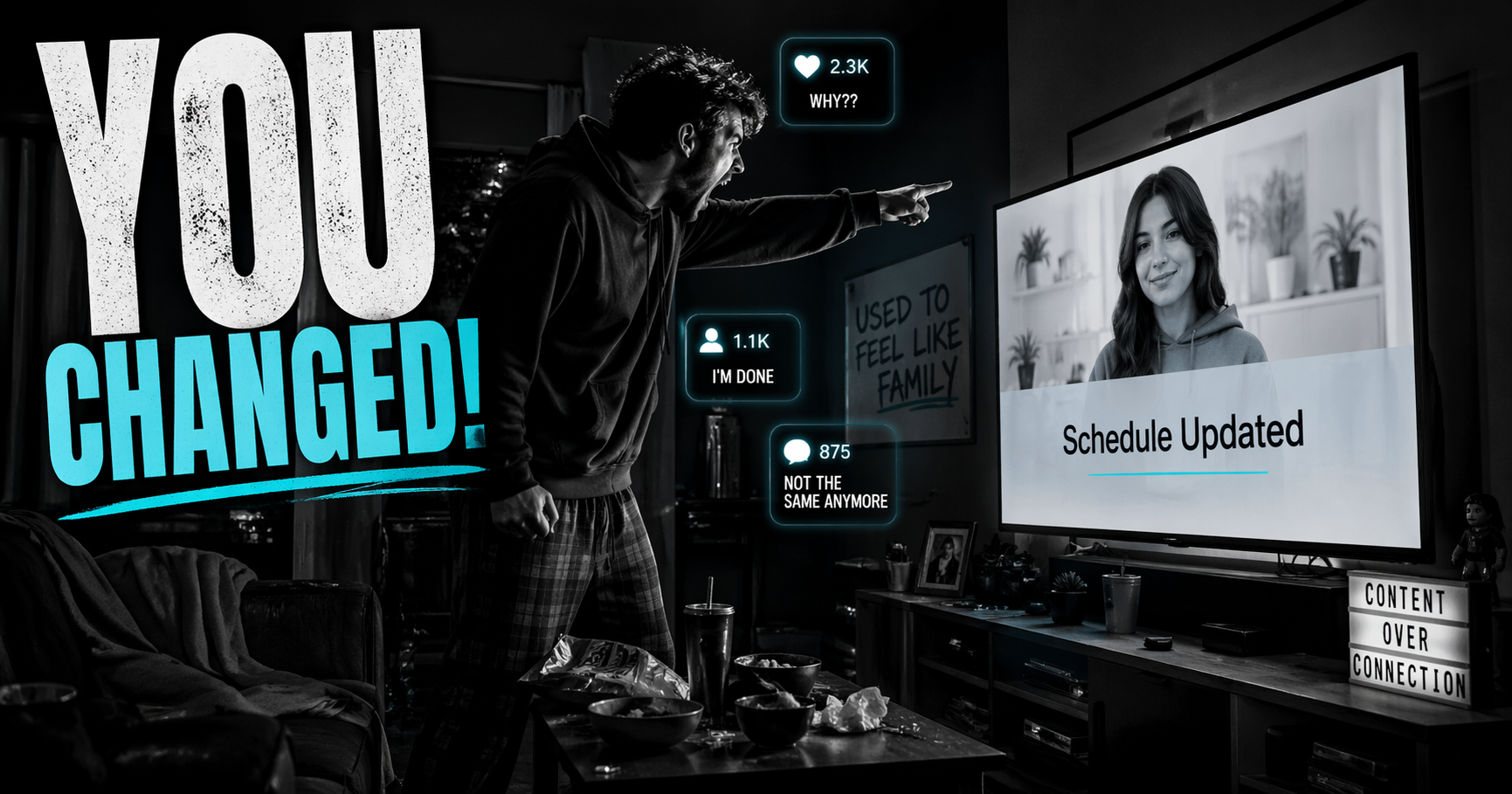
We've seen it go from "you changed" to coordinated harassment inside of a week. People who were never in a disagreement with anyone decide they have opinions about a creator's character because someone they'd adopted as a parasocial companion told them they were wronged. The math doesn't work, until you understand that none of this was ever really about the creator. It was about what they represented in someone else's internal narrative: a story they didn't write and were never consulted on.
Here is what no one wants to say directly: the parasocial relationship, left unexamined, is a machine for generating entitlement. The viewer gives attention. Sometimes money. Consistent presence. In their framework, that's a transaction. They've invested. And investment implies return. When the return doesn't come in the form they expected, they don't conclude that their model was flawed. They conclude that they've been cheated.
This is not unique to bad people. It is the predictable output of a platform that monetizes intimacy while never being honest about what intimacy it's actually selling. TikTok does not tell you that the creator who just called your name on Live has done that two hundred times tonight and will not remember yours tomorrow. That would be bad for engagement metrics. The business model depends on you feeling close enough to come back, gift again, share the content, and recruit your friends. The parasocial bond is the product. You are both the customer and the raw material.
Which is why the hostility, when it comes, always feels like it's missing the right target. The creator didn't build the room with no exits and tell you it was a relationship. The platform did.
The more interesting question is what we owe each other in these spaces, if anything. The honest answer is: not much, but not nothing.
Creators who cultivate parasocial bonds for engagement and then express bewilderment when their audience behaves like emotionally invested stakeholders are working both sides of a deal they pretend doesn't exist. If your whole brand is built on manufactured intimacy, you don't get to act shocked when someone takes the intimacy seriously. That's fair criticism and it should be said.
But it also has to be said that an audience member who conflates access with relationship, and presence with friendship, and gifting with debt owed, is operating with a map of the territory that bears no resemblance to the actual terrain. The creator's job is not to be your friend. The creator's job is to make content. Any warmth you feel in that exchange is real. What it means is not.
TikTok Live debates were a particularly unforgiving arena for this because they created the additional illusion that the opp and I were peers in some ongoing intellectual project. We were not. I was running a debate format. They were joining a Live. Those are structurally different things even when they superficially look like the same conversation. When the format ends, no creator owes anyone continued access, continued engagement, or a justification for how they choose to run their show.
You can think someone is wrong about something. You can disagree with the way they ran the Live. You can leave and never come back. All of that is fair.
What you cannot do, and have it mean anything coherent, is be angry at someone for not being the person you invented.
That person was always yours. We were just pixels on your screen and a sound coming out of your speaker.
This is part of why End of a Species is in transition. If you want to understand where we're going and why, the support page is the best place to start. It explains the shift, what it means for the content, and how you can support what comes next.